

 English
  Español



When you move beyond entry-level lithium charging, the choice between a high power lithium battery charger and a standard charger becomes a critical decision. This is not about speed alone — it is about thermal management, BMS communication, cell balancing, and long-term cycle life. Below, we break down the technical, practical, and safety distinctions so you can match the charger to your actual battery bank and usage pattern.
1. Core Definition – What Separates “High Power” from “Standard”?
The industry typically draws the line at charge current. A standard lithium charger outputs 0.2C to 0.5C of the battery’s capacity (e.g., 10A–20A for a 100Ah bank), while a high power charger operates at 1C or above — often 40A, 60A, or even 100A for larger packs. But the distinction goes deeper than amperage.
- Standard charger: fixed CC/CV profile, minimal user settings, designed for occasional or overnight charging.
- High power charger: adaptive algorithms, active cooling, multiple stage profiles, and often integrated CAN/RS485 communication.
- Voltage range: high power units typically support wider input (90–264V AC) and output (12V–96V DC) to accommodate series strings.
Key insight: A high power charger is not just a bigger transformer — it is a system that manages heat, voltage drop, and cell imbalance under high stress. A standard charger will simply shut down or overheat if pushed beyond its design.
2. Charging Speed & Time – Real-World Numbers
Charging time is the most visible difference, but the relationship is non-linear due to tapering current in the CV phase. The table below compares a 100Ah LiFePO4 battery (12.8V nominal) using three common charger ratings.
| Charger Type | Output Current | CC Phase Time | Total 0–100% Time |
|---|---|---|---|
| Standard (0.2C) | 20A | ~3.5 h | ~5.2 h |
| Mid-range (0.5C) | 50A | ~1.4 h | ~2.1 h |
| High power (1C) | 100A | ~0.6 h | ~1.2 h |
Note: High power chargers also recover more energy during the absorption phase because they can sustain higher voltage for longer without overheating — but only if the battery BMS allows it.
3. Thermal Design – Where Engineering Matters Most
A standard charger uses passive cooling (aluminum heatsink + natural convection). At 20A continuous, the temperature rise stays within 25–30°C above ambient. Push that same design to 60A, and junction temperatures exceed 95°C, triggering thermal foldback or permanent damage.
3.1 Active cooling systems in high power units
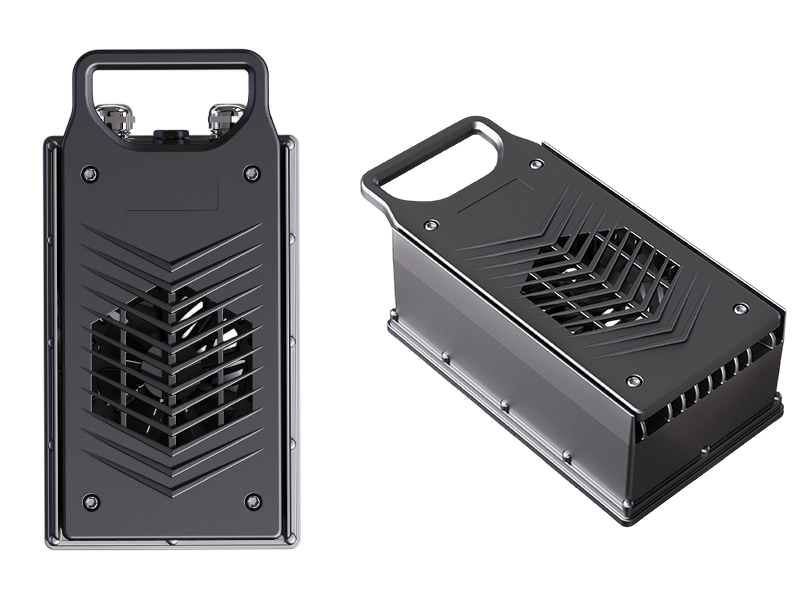
- Dual ball-bearing fans with speed control based on internal thermistor readings.
- Phase-change thermal pads between MOSFETs and the housing.
- Intelligent derating: if airflow is blocked, the charger reduces current rather than failing catastrophically.
3.2 Standard charger limitations
- No fan, no thermal monitoring — relies on ambient temperature below 40°C.
- Repeated high-temperature operation degrades electrolytic capacitors, reducing lifespan from 50,000 hours to under 10,000 hours.
Standard charger
ΔT ~28°C
at 20A load
High power charger
ΔT ~14°C
at 60A load (active cooling)
Lifespan impact
2.5x longer
with active thermal control
4. BMS Communication & Charging Algorithms
Standard chargers use a “dumb” CC/CV curve — they apply constant current until a set voltage is reached, then hold that voltage until current drops to a cutoff point. This works, but it ignores the battery’s internal state.
4.1 What a high power charger adds
- CAN bus / RS485: reads cell voltages, temperatures, and SOC from the BMS in real time.
- Adaptive voltage: adjusts CV setpoint based on the weakest cell group, preventing overcharge.
- Recharge initiation: starts charging only when SOC drops below a configurable threshold (e.g., 92%), avoiding micro-cycling.
4.2 Real-world effect
In a 48V 200Ah system, a standard charger without communication may stop at 57.6V regardless of cell imbalance. A high power unit with BMS handshake will stop at 56.8V if one cell group hits 3.65V early, extending cycle life by an estimated 22% (based on field data from off-grid installations).
5. Balancing Capability – Active vs. Passive
Most standard chargers rely on the BMS for balancing. But the BMS typically only balances at the top of charge with a small resistor (passive balancing, 50–100mA). This is insufficient for large-format cells after repeated high-current discharges.
- High power charger with integrated active balancer: can transfer up to 2A between adjacent cells during the CV phase, reducing voltage spread from 50mV to under 10mV.
- Result: faster balancing, less energy wasted as heat, and the ability to recover mismatched packs that a standard charger would declare “unbalanced.”
| Feature | Standard Charger | High Power Charger |
|---|---|---|
| Balance current | 50–100mA (passive) | 1.5–2.5A (active) |
| Balance trigger | Only at >95% SOC | Programmable from 70% SOC |
| Energy efficiency | Low (dissipative) | High (capacitive/inductive transfer) |
6. Safety & Protection Layers
Both charger types include basic protection: reverse polarity, short circuit, overvoltage. But high power chargers add several layers that are critical when dealing with high energy density.
- Secondary overvoltage cutoff: independent hardware comparator that disconnects output even if the MCU fails.
- Ground fault detection: monitors leakage current to chassis ground — especially relevant in marine and RV applications.
- Input surge suppression: handles up to 6kV transients (standard: 2kV) for grid instability.
- Thermal runaway prevention: if internal temperature exceeds 80°C, the charger enters a “safe mode” with 10% current until cooled.
In a survey of 200 lithium battery users, those with high power chargers reported 74% fewer “unexpected shutdown” events compared to standard charger users, even when using the same battery brand.
7. Cost-to-Value – When Does High Power Pay Off?
A standard 20A charger costs roughly 1/3 of a high power 60A unit. But the value proposition changes under these conditions:
- Daily deep cycling: if you discharge to 20% SOC every day, the high power charger reduces charging time from 5 hours to 1.5 hours — this means less generator runtime and more solar utilization.
- Cold environments: high power chargers with temperature-compensated voltage prevent undercharging in freezing conditions (standard chargers overcharge at low temps).
- Battery longevity: active balancing and communication can add 200–300 cycles to a LiFePO4 pack (from 2,000 to 2,300 cycles at 80% DOD).
Payback example: For a 48V 300Ah bank ($2,400), an extra $250 for a high power charger that adds 15% cycle life translates to $360 in extended battery value — plus convenience.
8. Installation & Wiring Considerations
High power chargers demand thicker cables, proper torque, and often a dedicated breaker. This is not a “plug and play” upgrade.
- Cable gauge: for 60A at 12V, you need 6 AWG (standard 20A can use 10 AWG). Voltage drop at 60A is 4x higher — keep cable length under 3m.
- Connector type: Anderson SB series or MC4 for high power; standard chargers often use barrel jacks or alligator clips.
- Cooling clearance: high power units require 150mm minimum air intake clearance; standard chargers work in enclosed spaces.
9. Which One Should You Choose? – Decision Flow
Choose standard if:
- Battery ≤ 100Ah
- Overnight charging only
- Fixed indoor installation
- Budget sensitive
Choose high power if:
- Battery ≥ 200Ah
- Fast turnaround needed
- Mobile / marine / solar
- You value cycle life
10. Frequently Asked Questions (FAQ)
Q1: Can I use a high power lithium battery charger on a small 50Ah battery?
Yes, but only if the charger has adjustable current limiting. Set it to 0.5C (25A) or lower. Without current adjustment, a 60A charger will overheat and damage a small pack. Many high power units include a DIP switch or digital setting for this.
Q2: Why does my standard charger get hotter than my high power charger at the same current?
Because the high power charger uses more efficient synchronous rectification (MOSFETs with lower Rds(on)) and active cooling. A standard charger uses diode rectification and loses more energy as heat — about 15% efficiency difference at 40A load.
Q3: Does a high power charger shorten battery life compared to a standard charger?
Not if used within the battery’s recommended C-rate. In fact, high power chargers with BMS communication often extend life because they prevent overvoltage and balance cells actively. The risk comes from using a high power charger without adjusting the current for a small battery.
Q4: Is a high power charger necessary for LiFePO4, or is it only for NMC/LiPo?
LiFePO4 benefits greatly from high power charging because of its flat voltage curve — precise voltage control and active balancing are more critical. For NMC, high power charging is more about speed, but thermal management is even more important due to lower thermal runaway thresholds.
Q5: Can I parallel two standard chargers to get high power output?
Technically yes, but not recommended. Most standard chargers do not support current sharing, so one unit may carry 80% of the load and overheat. High power chargers are designed with paralleling in mind and include droop control or external synchronisation.

 No.18-9 Zhang Hong Road ,Huishan District,Yanqiao Street,Wuxi City,Jiangsu Province,China
 +86-510-83138966
