English
  Español


DPOWER ELECTRONIC
DPOWER ELECTRONIC
DPOWER ELECTRONIC
DPOWER ELECTRONIC
DPOWER ELECTRONIC
DPOWER ELECTRONIC
Thermodynamic and Electrochemical Analysis of CC/CV Transition in a Lithium 24V Battery Charger
 Home / News / Industry News / Thermodynamic and Electrochemical Analysis of CC/CV Transition in a Lithium 24V Battery Charger
Content
May 10, 2026
1. The CC/CV transition accuracy of a lithium 24v battery charger directly governs the lithium-ion intercalation rate; an imprecise shift to constant voltage (CV) can lead to localized over-potential at the cathode-electrolyte interface.
2. When analyzing how CC/CV accuracy affects LiFePO4 cycle life, engineers focus on the prevention of lithium plating on the graphite anode, which typically occurs if the lithium 24v battery charger maintains high current (CC phase) beyond the electrochemical saturation point.
3. For a precision-engineered lithium 24v battery charger, the transition voltage is typically calibrated to 28.8V or 29.2V for a 24V (8S) LiFePO4 string, with a tolerance threshold tighter than 50mV.
4. The impact of charge termination current on battery capacity retention is a vital metric; if the lithium 24v battery charger cuts off too early or persists with micro-currents, it can cause irreversible capacity fade and internal resistance growth.
1. Why peak conversion efficiency matters for lithium 24v battery chargers: High-efficiency SMPS architectures (typically exceeding 94 percent) reduce waste heat, ensuring that the lithium 24v battery charger does not contribute to the ambient thermal stress of the battery enclosure.
2. In a lithium 24v battery charger, the use of synchronous rectification and high-frequency transformers allows for a compact footprint while maintaining a low output ripple voltage, which should not exceed 1 percent of the nominal 24V output to prevent parasitic heating.
3. Comparing 24V lead-acid vs lithium battery chargers reveals that lithium units must lack a "desulfation" or "float" stage, as these high-voltage pulses can damage the tensile strength of the internal separator and trigger BMS over-voltage protection.
4. The benefits of CAN-bus communication for 24v lithium chargers include real-time voltage and temperature feedback, allowing the charger to dynamically adjust the CC/CV setpoints based on the actual cell-level data provided by the BMS.
1. Analyzing the low-temperature charging safety of lithium chargers: Charging LiFePO4 below 0 degrees Celsius is hazardous; a lithium 24v battery charger must feature an integrated temperature sensor or BMS link to inhibit current flow until the battery temperature is normalized.
2. The impact of output ripple on lithium-ion internal resistance is evaluated through long-term aging tests, where high ripple currents can accelerate the degradation of the Solid Electrolyte Interphase (SEI) layer.
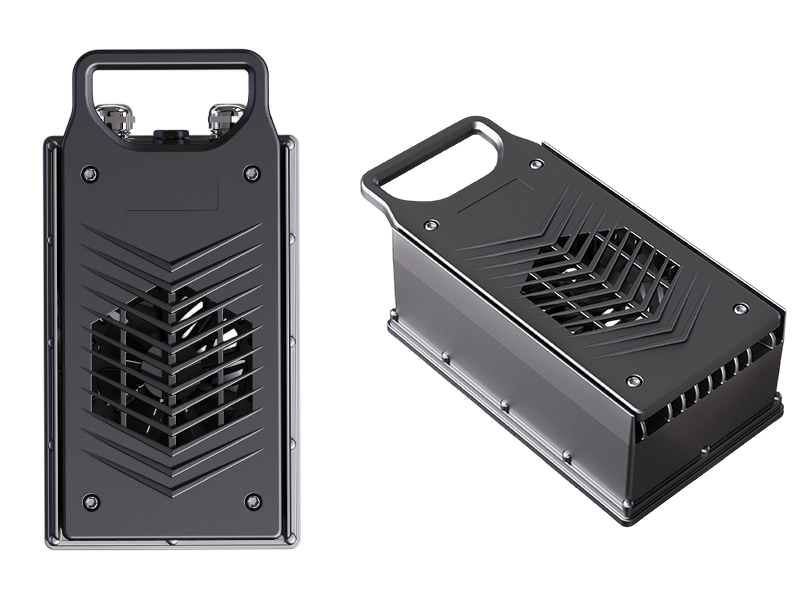
3. Achieving an Ra surface finish of 3.2 micrometers on the aluminum heat sink fins ensures optimal convection cooling, a critical factor for lithium 24v battery charger units operating in unventilated industrial environments.
4. Operational Performance and Threshold Matrix:
| Engineering Metric | Industrial Standard | lithium 24v battery charger (Precision Grade) |
| Voltage Regulation Accuracy | +/- 1.0 percent | +/- 0.2 percent |
| Efficiency (Full Load) | 88 percent | >94 percent |
| Isolation Voltage (Hi-Pot) | 1500V AC | 3000V AC |
| Transition Convergence | Soft Knee | Active PWM Slope Control |
1. Preventing thermal runaway with real-time BMS feedback: The lithium 24v battery charger should act as a secondary safety layer, immediately ceasing power delivery if the BMS reports a cell voltage deviation exceeding 300mV.
2. Testing the EMC compliance of industrial battery chargers: To prevent interference with sensitive automation sensors, the lithium 24v battery charger must comply with EN 61000-6-3 for electromagnetic compatibility.
3. Optimizing potting compounds for vibration resistance in 24V chargers: Utilizing high-thermal-conductivity epoxy resin improves the mechanical tensile strength of the internal component mounting, essential for chargers used on mobile AGVs or golf carts.
1. Can I use a 24V lead-acid charger for my lithium battery?
No. Lead-acid chargers often include an equalization stage with voltages exceeding 30V, which can destroy LiFePO4 cells. A dedicated lithium 24v battery charger uses a strict CC/CV profile without these pulses.
2. What happens if the CC/CV transition is inaccurate?
If the transition voltage is too high, the lithium 24v battery charger will overstress the electrolyte. If too low, the battery will never reach a 100 percent State of Charge (SOC), leading to cell imbalance over time.
3. How does high ripple voltage affect battery health?
Excessive ripple from a lithium 24v battery charger causes micro-cycling of the battery, which increases the internal temperature and speeds up the growth of the SEI layer, raising internal resistance.
4. Why is CAN-bus communication becoming a standard?
It allows the lithium 24v battery charger and the battery to "talk," ensuring the charger only provides the exact current the BMS can handle based on current cell temperatures and voltages.
5. What is the ideal termination current for a 100Ah 24V lithium battery?
For most LiFePO4 systems, the lithium 24v battery charger should terminate the CV phase when the current drops to 0.05C (5A for a 100Ah pack) to ensure the cells are fully saturated but not over-stressed.
1. IEC 60335-2-29: Particular requirements for battery chargers.
2. UN 38.3: Manual of Tests and Criteria for Lithium Batteries and Equipment.
3. IEEE 1625: Standard for Rechargeable Batteries for Multi-Cell Mobile Computing Devices.

 No.18-9 Zhang Hong Road ,Huishan District,Yanqiao Street,Wuxi City,Jiangsu Province,China
 +86-510-83138966
 [email protected]
TALK TO US
Copyright © Wuxi Dpower Electronic Co., Ltd. All Rights
Reserved.
Custom Smart Lithium Battery Charger Manufacturer