E-Bike Battery Charger: The Complete Guide to Performance, Safety, and Longevity
The global surge in electric mobility has placed the e-bike battery charger at the heart of the user experience. Far from being a simple accessory, the charger is a sophisticated power electronics device that directly influences battery lifespan, riding range, safety, and overall ownership satisfaction. As e-bikes evolve from simple pedal-assist models to high-performance vehicles, the demands on their charging systems have intensified. This guide delves deep into the technology, selection criteria, and future trends surrounding the e-bike battery charger, providing essential knowledge for manufacturers, fleet operators, and informed riders alike.
Fundamental Parameters of an E-Bike Battery Charger
Selecting the correct e-bike battery charger begins with understanding its core electrical specifications. Mismatching these parameters can lead to poor performance, reduced battery life, or even hazardous situations. The charger must act as a perfect partner to the battery's Battery Management System (BMS).
Voltage: The Critical Match
The output voltage of the charger must precisely match the nominal voltage of the e-bike battery pack. A common misconception is that a 36V battery charges at 36V; in reality, it requires a higher voltage to reach full capacity. For instance, a 36V (10S) lithium-ion pack requires a charger with an output of 42V. Similarly, a 48V (13S) pack needs a 54.6V charger, and a 52V (14S) pack requires a 58.8V charger. Using a charger with incorrect voltage will either under-charge or dangerously over-charge the cells.
- Nominal vs. Charge Voltage: The nominal voltage is the average operating voltage, while the charge voltage is the higher "constant voltage" (CV) level needed to fully saturate the cells.
- Compatibility Check: Always verify the charger's output voltage against the battery's label or specifications. The BMS is designed for a specific voltage range, and the charger must operate within that range.
Current (Amperage) and Charging Speed
The output current, measured in Amperes (A), dictates how quickly the battery charges. A higher amperage e-bike battery charger will replenish the battery faster, but this speed must be within the battery's acceptable charge rate (often denoted as "C-rate"). Charging at 0.5C (e.g., 5A for a 10Ah battery) is a common balance between speed and cell longevity.
- Standard Charge (2A-4A): Ideal for overnight charging or for smaller battery packs (e.g., 36V 8-10Ah). It generates less heat and is gentler on the cells.
- Fast Charge (5A-8A): Suitable for larger capacity packs (e.g., 48V 15-20Ah) or riders needing a quicker turnaround. Requires a battery BMS rated for this higher current.
- Ultra-Fast Charge (>8A): Typically found in high-capacity, performance-oriented e-bikes. These chargers often incorporate advanced cooling and require batteries specifically designed for high charge rates.
Below is a general guide correlating charger current with typical charging times for a common 48V 14Ah battery (approx. 672Wh).
| Charger Current (Amps) |
Approx. Charge Time (0-100%) |
Typical Application |
| 2A |
6-7 hours |
Overnight charging, basic commuter e-bikes |
| 4A |
3-4 hours |
Standard daily charging, mid-range e-bikes |
| 5A |
2.5-3 hours |
Fast charging for larger packs, performance models |
| 8A |
1.5-2 hours |
High-speed charging for long-range touring or fleet use |
The Technology Inside Modern E-Bike Chargers
Today's e-bike battery charger is a smart device, far removed from the simple transformers of the past. It integrates power electronics, microcontrollers, and communication protocols to ensure safe and efficient energy transfer.
The Charging Algorithm: CC/CV Explained
All quality lithium-ion chargers utilize the Constant Current / Constant Voltage (CC/CV) algorithm. This two-stage process is essential for lithium battery health.
- Constant Current (CC) Stage: The charger delivers a steady, pre-set current to the battery while the voltage gradually rises. This is the "bulk" charge phase, where the battery absorbs the majority of its energy.
- Constant Voltage (CV) Stage: Once the battery voltage reaches its peak (e.g., 42V for a 36V pack), the charger switches to constant voltage mode. The current begins to taper down as the battery reaches full saturation. The charge cycle ends when the current drops to a predetermined cut-off level, preventing overcharging.
Intelligent Communication: The Charger-BMS Dialogue
Modern e-bike batteries contain a Battery Management System (BMS) that monitors cell voltages, temperature, and state of charge. Advanced e-bike battery chargers can communicate directly with the BMS to optimize the charging process. This is particularly crucial for high-capacity packs and those using advanced lithium chemistries.
- Protocols in Use: Communication is typically handled via protocols like UART (simpler, point-to-point) or CAN bus (more robust, suitable for complex systems). The charger receives real-time data from the BMS, such as maximum allowed current or cell temperature.
- Benefits of Communication: This dialogue enables dynamic adjustment of the charge current, early error detection (e.g., a cell imbalance), and can even initiate a balancing cycle at the end of charge. A charger that communicates with the BMS provides an additional layer of safety and can extend overall pack life.
Safety Features: Non-Negotiable Elements of a Quality Charger
Given the energy density of lithium-ion batteries, safety is paramount. A reputable e-bike battery charger must incorporate multiple layers of protection to safeguard users, property, and the battery itself.
Essential Protection Mechanisms
- Overvoltage Protection (OVP): Prevents the charger from outputting a voltage higher than a safe threshold, protecting the BMS and cells.
- Overcurrent Protection (OCP): Shuts down or limits the output current if it exceeds a predefined limit, preventing stress on the charger and battery.
- Short Circuit Protection (SCP): Instantly cuts the output in the event of a short circuit at the charger's output terminals or connectors.
- Reverse Polarity Protection: Prevents damage if the charger is accidentally connected to the battery with reversed positive and negative leads. This is often implemented using a fuse or a MOSFET-based ideal diode circuit.
- Over-Temperature Protection (OTP): Internal sensors monitor the charger's temperature. If it exceeds safe operating limits, the charger will reduce power or shut down until it cools.
Thermal Management: Fan vs. Fanless Designs
Managing heat is critical for both performance and longevity. Two primary cooling strategies exist for e-bike battery chargers.
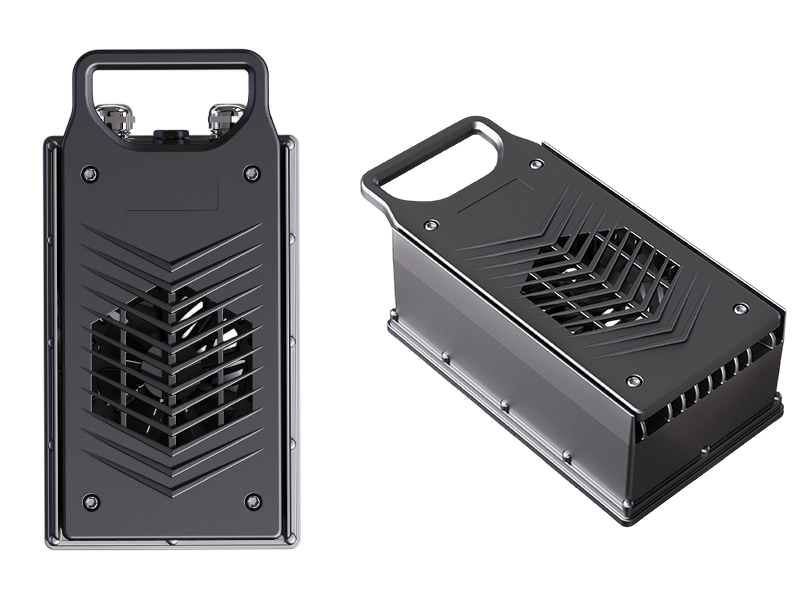
- Active Cooling (with fan): Common in compact, high-power chargers. A fan forces air over internal heatsinks. While effective, fans are mechanical parts that can fail, accumulate dust, and generate noise.
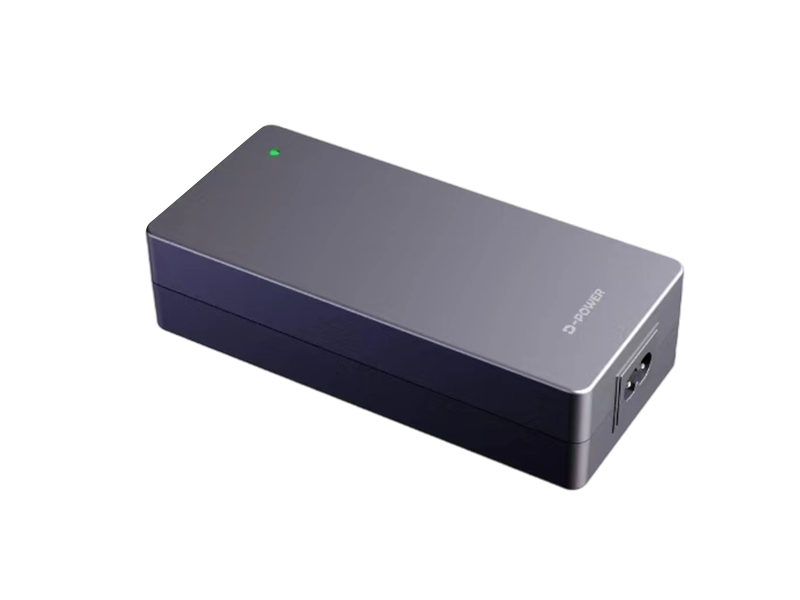
- Passive Cooling (fanless/natural convection): Utilizes the charger's casing as a large heatsink. This design is completely silent, has no moving parts to fail, and is inherently more reliable, though it may result in a slightly larger physical size for high-power models.
The choice between fan and fanless often depends on the application's priority: compact size and maximum power density (favoring fans) versus absolute reliability and silence (favoring fanless designs).
Connector Types and Mechanical Compatibility
The physical connection between the charger and the battery is a critical interface. The market uses several standard connectors, and the e-bike battery charger must be equipped with the correct mating part for the specific battery.
Common E-Bike Charger Connectors
- Barrel Connector (5.5mm x 2.1mm / 2.5mm): Common on many entry-level and mid-range e-bikes, particularly those with rack or downtube batteries. Simple and cost-effective, but polarity must be observed (typically center positive).
- XLR Connector (3-pin): A robust, locking connector often found on higher-quality e-bikes and some European models. The three pins can be used for power plus communication or balance leads.
- RCA Connector: Occasionally used on older or specific brand models.
- Proprietary Connectors: Many major e-bike brands (e.g., Bosch, Brose, Yamaha) use their own unique connector designs that integrate power, communication, and sometimes mechanical locking mechanisms. These often require brand-specific chargers or adapter cables.
Importance of Connector Quality
A poor-quality connector can introduce resistance, leading to heat buildup, voltage drop, and potential fire risk. High-grade connectors feature gold-plated contacts for corrosion resistance and low resistance, along with strain relief to protect the cable from damage at the entry point. For any OEM or custom project, specifying the exact connector is a crucial step in the e-bike battery charger design process.
Selecting the Right E-Bike Battery Charger for Your Needs
Whether you are an OEM manufacturer, a fleet operator, or an individual rider, choosing the optimal e-bike battery charger involves balancing several factors. A systematic approach ensures compatibility, performance, and value.
Key Selection Criteria
- 1. Electrical Compatibility: This is non-negotiable. Match the charger's output voltage and current limits to the battery's specifications (as defined by its BMS). The charger's output voltage must be correct, and its maximum current must not exceed the battery's maximum charge rate.
- 2. Physical Connection: Ensure the charger's output connector matches the battery's input port. For custom applications, this is an opportunity to specify a robust, reliable connector.
- 3. Charging Speed & Use Case: For individual owners, a standard 2A-4A charger is often sufficient and battery-friendly. For commercial fleets (e.g., bike-sharing, delivery services), faster charging (5A-8A) is essential to maximize vehicle uptime.
- 4. Communication Needs: If the battery features a "smart" BMS that communicates via CAN or UART, select a charger that supports the same protocol. This enables optimized charging curves and diagnostic capabilities.
- 5. Environmental Factors: Consider where the charger will be used. Indoor use is typical, but if charging takes place in a garage, workshop, or outdoors, a charger with a higher ingress protection (IP) rating, such as IP54 (dust and water splash resistant), may be necessary.
- 6. Certification and Compliance: Look for chargers that carry recognized safety certifications such as CE (European Conformity), UL (Underwriters Laboratories), or FCC (Federal Communications Commission). These certifications indicate the product has been tested for safety and electromagnetic compatibility.
Maintenance and Best Practices for Longevity
Proper care of your e-bike battery charger and charging habits can significantly extend the life of both the charger and the battery. Simple practices make a substantial difference.
Charging Habits for Battery Health
- Avoid Deep Discharges: Lithium-ion batteries prefer partial discharges. Regularly charging before the battery is empty (e.g., above 20%) reduces stress.
- Store at Partial Charge: If storing the e-bike for an extended period (more than a few weeks), store the battery at around 50-60% charge in a cool, dry place. Do not store it fully charged or fully empty.
- Use the Correct Charger: Always use the charger specifically designed for your battery. Avoid using "universal" chargers that may not follow the correct CC/CV profile or communicate properly.
- Charge in a Safe Environment: Charge on a non-flammable surface, away from direct sunlight, extreme heat, or moisture. Ensure the charger has adequate ventilation.
Charger Maintenance Tips
- Inspect Cables and Connectors: Periodically check the charger's AC power cord and DC output cable for cuts, fraying, or damage. Inspect the connector for bent pins or corrosion.
- Keep it Clean: Unplug the charger and wipe it down with a dry cloth to remove dust and debris. For fan-cooled chargers, ensure the air intake and exhaust vents are not blocked.
- Protect from Physical Stress: Avoid wrapping the cable too tightly around the charger body, as this can stress the internal wires. Carry the charger carefully to prevent drops or impacts.
FAQ: E-Bike Battery Charger
Can I leave my e-bike battery charger plugged in all the time?
Modern, quality e-bike battery chargers are designed with intelligent microcontrollers that automatically stop charging once the battery is full. They typically enter a standby or maintenance mode, drawing negligible power. However, as a best practice for ultimate safety and energy conservation, it is advisable to unplug the charger once charging is complete. This eliminates any remote risk of a fault developing over an extended period and protects against power surges. While leaving it plugged in occasionally is generally safe with a good charger, making it a habit to unplug after use is a simple step toward enhanced safety.
How long does an e-bike battery charger last?
The lifespan of an e-bike battery charger varies significantly based on its build quality, usage patterns, and environmental conditions. A high-quality charger, such as those designed with robust components and rigorous testing, can last for 3 to 5 years or even longer. Key factors influencing longevity include the quality of internal capacitors (which can degrade over time), thermal stress (excessive heat is a primary enemy), and the reliability of any cooling fans (fanless designs often last longer due to the absence of moving parts). Regular inspection and proper usage, as outlined above, will help maximize its operational life.
What happens if I use the wrong charger for my e-bike battery?
Using the wrong e-bike battery charger can have serious consequences. If the charger's voltage is too high, it will force excessive current into the battery, bypassing safety limits, leading to severe overheating, potential fire, and permanent destruction of the battery cells. If the voltage is too low, the battery will not charge fully, leading to reduced range. Using a charger with the correct voltage but too high amperage may trip the battery's BMS protection, or if the BMS is not adequately rated, it can overheat the internal wiring and cells. Using a charger with a different connector might also cause a short circuit. Always ensure the replacement charger exactly matches the original's voltage, current, and connector type.
Can I charge my e-bike battery with a fast car charger?
No, you should never attempt to charge an e-bike battery directly with a car battery charger. Car chargers are designed for lead-acid batteries and use a completely different charging algorithm (often constant voltage only) that is incompatible with and dangerous for lithium-ion cells. Furthermore, the voltage levels are mismatched. While you can use an inverter connected to a car's 12V outlet to power your standard e-bike battery charger (provided the inverter and charger's power draw are within the car's limits), this is indirect and less efficient. Direct connection is hazardous and will almost certainly damage the battery and pose a significant safety risk.
How do I know when my e-bike battery is fully charged?
Most e-bike battery chargers provide clear visual indicators of charging status. The most common method is a multi-color LED (Light Emitting Diode). Typically, a red or orange light indicates that the charger is in the Constant Current (bulk) stage and actively charging. The light then changes to green or blue once the charger enters the Constant Voltage stage and the battery nears full capacity. Some advanced chargers may feature a digital display showing voltage, current, or charge percentage. Additionally, many e-bike batteries themselves have a built-in charge indicator button and LEDs. When both the charger light is green, and the battery's own indicator shows full, the process is complete.
Is it safe to charge an e-bike battery indoors?
Charging an e-bike battery indoors is a common practice, but it should be done with awareness. While modern lithium-ion batteries and quality chargers are inherently safe, it is wise to follow precautions. Always charge on a hard, non-flammable surface like a stone or concrete floor, away from flammable materials such as curtains, paper, or bedding. Ensure the area is well-ventilated and that the charger is not covered. Use only the charger supplied with the battery or a certified replacement. Never charge a battery that shows signs of physical damage, swelling, or overheating. Many manufacturers also recommend not charging unattended overnight as an extra safety measure, despite the built-in protections.
What is the difference between a 2A and a 5A e-bike charger?
The primary difference is the charging speed. A 2A e-bike battery charger delivers 2 Amperes of current to the battery, resulting in a slower, gentler charge. It is ideal for smaller batteries or for users who charge overnight and are not in a hurry. A 5A charger delivers 5 Amperes, more than doubling the charging speed. This is beneficial for larger capacity batteries and riders who need a quick top-up. However, faster charging generates more heat, sothe battery's BMS must be rated to accept 5A. While convenient, consistent use of fast charging may lead to marginally faster battery aging compared to always using a slower charge, though for most users, the convenience outweighs this minor effect.


 English
  Español




 Watch Our Video


 No.18-9 Zhang Hong Road ,Huishan District,Yanqiao Street,Wuxi City,Jiangsu Province,China
 +86-510-83138966
