Power Tools Battery Charger: Engineering Reliability for Demanding Applications
The evolution of cordless power tools has been nothing short of revolutionary, and at the heart of this transformation lies the power tool battery charger. No longer a simple afterthought, the charger is a sophisticated power electronics system that directly impacts job site productivity, tool runtime, battery pack longevity, and overall return on investment. Professional users and tool manufacturers alike recognize that the charger is as critical as the tool itself. A high-performance power tool battery charger must deliver rapid energy replenishment without compromising safety, withstand harsh environmental conditions, and communicate intelligently with advanced battery management systems.
Wuxi Dpower Electronic Co., Ltd., founded in 2014 near the scenic Taihu Lake, brings deep expertise to this demanding field. Strategically located just 1 km from the Wuxi North highway exit—approximately 100 km from Shanghai and 30 km from Suzhou—we leverage convenient transportation and rich industrial resources. As a China-based specialist in high-end lithium battery chargers and power supplies, our solutions serve the full spectrum of applications, including power tools, e-bikes, drones, scooters, and AGVs. This guide explores the essential technologies, performance parameters, and selection criteria for modern power tools battery charger systems, providing actionable insights for engineers, procurement professionals, and informed users.
Core Architecture of Power Tool Chargers
Understanding the internal architecture of a power tool's battery charger reveals why quality varies so widely between products. Professional-grade chargers incorporate multiple functional stages working in concert to deliver safe, fast, and reliable charging.
Power Conversion Topology
The power stage converts AC mains electricity into precisely controlled DC output suitable for lithium-ion battery packs. Modern designs achieve efficiencies exceeding 90%, minimizing energy waste and internal heat generation.
- Active Power Factor Correction (PFC): Professional chargers incorporate active PFC circuits that shape the input current waveform to match the voltage waveform, achieving power factors above 0.96. This reduces harmonic pollution on job site generators and allows higher power output from standard wall outlets.
- High-Frequency Switching: Advanced topologies like phase-shifted full bridge or LLC resonant converters operate at frequencies above 100 kHz, enabling smaller magnetic components and more compact charger designs.
- Synchronous Rectification: Replacing traditional diodes with low-resistance MOSFETs in the output stage reduces conduction losses, particularly important for high-current chargers above 8A.
- Wide Input Voltage Range: Professional chargers accommodate 90-264 VAC, 50/60 Hz input, ensuring worldwide compatibility regardless of local grid conditions.
The table below summarizes typical power stage parameters for different classes of power tool chargers.
| Charger Class |
Output Current |
Efficiency |
Power Factor |
Typical Applications |
| Standard |
2A - 4A |
85-88% |
0.70-0.85 (passive) |
Entry-level tools, home use |
| Fast |
5A - 8A |
88-91% |
>0.95 (active PFC) |
Professional tools, high-demand use |
| Super-Fast |
9A - 15A+ |
91-94% |
>0.98 (active PFC) |
Industrial, heavy-duty, fleet charging |
Charging Algorithm: The CC/CV Foundation
Every quality powetoolls battery charger for lithium-ion batteries implements the Constant Current / Constant Voltage (CC/CV) algorithm. This two-stage process is fundamental to battery safety and longevity.
- Constant Current (CC) Phase: The charger delivers a steady, pre-set current while the battery voltage rises. This is the bulk charging stage, where the pack absorbs the majority of its energy. For a 5-cell (18V nominal) pack, voltage rises from approximately 15V to 21V during this phase.
- Constant Voltage (CV) Phase: Once the pack reaches its absorption voltage (typically 4.2V per cell, e.g., 21V for 5 cells), the charger maintains constant voltage while the current naturally tapers down. This prevents overcharging and allows cells to reach full saturation.
- Termination Criteria: Charging ends when the current drops below a threshold (typically 5-10% of the rated current), ensuring the pack is fully charged without stressing cells.
- Temperature Monitoring: Professional chargers monitor battery temperature via NTC thermistors in the battery pack, adjusting or aborting charge if temperatures exceed safe limits (typically 0°C to 45°C for charging).
Fast Charging Technologies and Trade-offs
The demand for rapid charging in professional environments continues to drive innovation in power tool battery charger design. However, speed must be balanced against battery life and thermal management.
Multi-Stage Fast Charging
Advanced chargers employ sophisticated algorithms to accelerate charging while protecting cell health.
- Pre-Charge Conditioning: For deeply discharged batteries (below 2.5V per cell), a low current pre-charge safely restores cells before applying full current.
- Boost Charging: Some chargers apply an elevated current for the initial portion of the CC phase, then reduce current as the pack approaches full charge to minimize stress.
- Pulse Charging: Research suggests that pulse charging with brief relaxation periods can reduce internal impedance and improve charge acceptance, though adoption in commercial tools remains limited.
Thermal Management in Fast Charging
High charge rates generate significant heat, making thermal management critical for both charger and battery safety. Professional power tools battery charger designs employ several strategies.
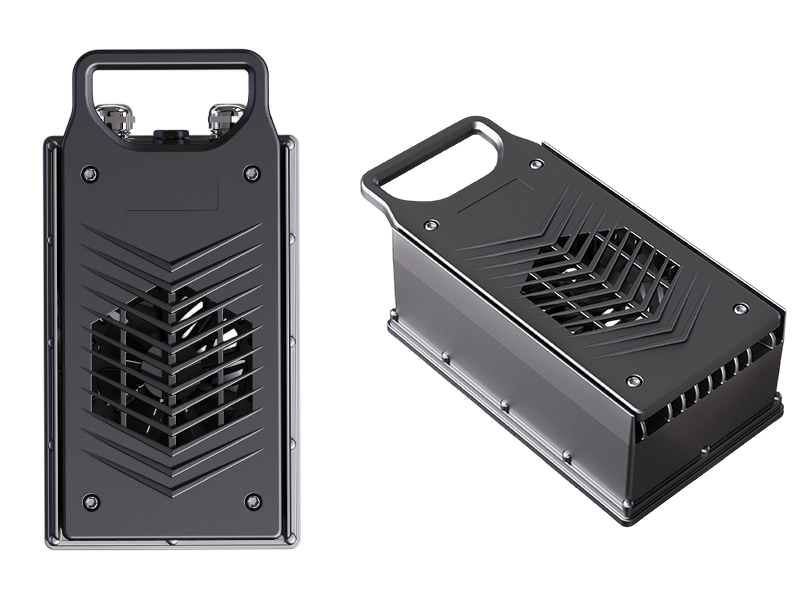
- Active Cooling (Fan): Most fast chargers include temperature-controlled fans that force air through the charger and often across the battery pack itself during charging. This reduces internal temperatures and allows higher sustained charge rates.
- Passive Cooling (Fanless): Some premium chargers for less demanding applications use natural convection with optimized heatsink designs, offering silent operation and higher reliability through the elimination of moving parts.
- Thermal Derating: Smart chargers monitor internal temperature and automatically reduce charge current if thermal limits are approached, preventing overheating without abrupt shutdown.
The table below compares cooling strategies for power tool chargers.
| Cooling Method |
Advantages |
Disadvantages |
Typical Applications |
| Fan (Active) |
Higher power density, faster charging, compact size |
Noise, dust accumulation, and fan failure potential |
Professional fast chargers, job sites |
| Fanless (Passive) |
Silent, no moving parts, higher reliability |
Larger size, lower sustained power |
Home use, benchtop chargers, sensitive environments |
| Hybrid (Fan + Heatsink) |
Balanced performance, temperature-controlled fan |
Complexity, cost |
Premium industrial chargers |
Intelligence and Communication
Modern power tools battery charger systems incorporate digital intelligence that transforms them from simple power supplies into active partners in battery management.
BMS Communication Protocols
Communication between the charger and the battery enables optimized charging and enhanced safety. Different protocols serve different market segments.
- Single-Wire Communication: Many power tool platforms use a simple single-wire interface where the battery transmits basic data like temperature and charge request. This low-cost approach is adequate for many applications.
- UART (Universal Asynchronous Receiver/Transmitter): Provides more comprehensive data exchange, including cell voltages, state of charge, and fault conditions, enabling sophisticated charging strategies.
- CAN Bus (Controller Area Network): Increasingly adopted in industrial and high-end professional tools, CAN provides robust, noise-immune communication essential for demanding environments.
Diagnostics and User Feedback
Professional users benefit from chargers that provide clear status information and diagnostic capabilities.
- Multi-Color LED Indicators: Standard status indication (red=charging, green=complete) is enhanced with blinking patterns indicating faults (over-temperature, cell imbalance, defective battery).
- Segmented Charge Display: Some advanced chargers use multiple LEDs or small segment displays to show approximate charge percentage during charging.
- Bluetooth Connectivity: Emerging technology allows chargers to connect to mobile apps, providing detailed battery health data, charge history, and alerts for maintenance needs.
- Acoustic Alerts: Buzzer or beeper confirmation of charge completion or fault conditions aids users in noisy environments.
Mechanical Design and Environmental Robustness
A powertools battery charger intended for professional use must withstand harsh job site conditions, including dust, moisture, impacts, and temperature extremes.
Enclosure and Ingress Protection
The physical construction of the charger directly impacts its durability and safety.
- Impact-Resistant Housing: Professional chargers use high-impact ABS or polycarbonate enclosures capable of surviving drops from workbenches or tool boxes.
- Ingress Protection (IP) Rating: Job site chargers typically target IP54 (dust-protected and splash-resistant) or higher. This requires sealed seams, gasketed interfaces, and protected vents.
- Strain Relief: Heavy-duty cable entries with molded strain relief prevent internal wire damage from repeated flexing and pulling.
- Non-Slip Feet: Rubber feet prevent the charger from sliding on smooth surfaces during battery insertion and removal.
Battery Interface and Connectors
The mechanical interface between charger and battery must endure thousands of insertion cycles while maintaining reliable electrical contact.
- Guide Rails and Keying: Precision-molded guide rails ensure proper battery alignment during insertion. Mechanical keying prevents incorrect battery types from being inserted.
- Contact Materials: High-quality contacts use gold-plating or similar corrosion-resistant materials to maintain low resistance over the charger's lifetime.
- Contact Pressure: Spring-loaded contacts with optimized pressure ensure consistent connection despite vibration or slight misalignment.
- Dust Covers: Some chargers include hinged dust covers that protect contacts when no battery is present.
Safety Standards and Certifications
Safety is paramount in power tools battery charger design, and compliance with recognized standards is essential for market access and user protection.
Key Safety Certifications
- UL 60335-2-29 / IEC 60335-2-29: The primary standard for battery chargers, covering electrical safety, abnormal operation, and component requirements for household and similar applications.
- UL 2595: General standard for battery-powered tools, covering the entire system, including charger safety requirements.
- CSA C22.2 No. 107.2: Canadian standard for battery chargers.
- EN 60335-2-29: European harmonized standard for charger safety, required for CE marking.
- FCC Part 15 / EN 55014: Electromagnetic compatibility standards ensuring chargers do not interfere with other electronic equipment.
Essential Safety Features
Beyond certification, specific safety features distinguish high-quality chargers.
- Reverse Polarity Protection: Prevents damage if battery contacts are incorrectly aligned.
- Short Circuit Protection: Instant output shutdown if a short circuit is detected.
- Over-Temperature Protection: Internal sensors shut down the charger or reduce output if temperatures exceed safe limits.
- Over-Voltage Protection: Prevents output voltage from exceeding safe levels even in fault conditions.
- Cell Balancing: Some chargers incorporate passive or active balancing circuits that equalize cell voltages during charging, maximizing pack capacity and lifespan.
Voltage Platforms and Compatibility
Power tool batteries are available in multiple voltage platforms, each requiring a compatible powertools battery charger with appropriate output characteristics.
Common Voltage Platforms
- 12V (Nominal): Used for compact screwdrivers, inspection cameras, and light-duty tools. Charge voltage: 12.6V (3S).
- 18V/20V Max (Nominal): The most common professional platform worldwide. 18V nominal (5S) charges to 21V; 20V Max (also 5S) is a marketing designation with identical charge requirements.
- 24V (Nominal): Used for higher-power tools and some outdoor equipment. Charge voltage: 29.4V (7S) or 25.2V (6S).
- 36V (Nominal): Increasingly common for outdoor power equipment (chainsaws, trimmers) and heavy-duty tools. Charge voltage: 42V (10S).
- 40V/60V/80V Max: Emerging platforms for ultra-high-power applications, requiring chargers with corresponding voltage ratings.
The table below summarizes common power tool battery configurations and charger requirements.
| Nominal Voltage |
Cell Configuration |
Charge Voltage |
Typical Applications |
| 12V |
3S |
12.6V |
Compact screwdrivers, inspection tools |
| 18V / 20V Max |
5S |
21.0V |
Drills, saws, impact wrenches, and lighting |
| 24V |
6S or 7S |
25.2V or 29.4V |
High-torque tools, outdoor equipment |
| 36V |
10S |
42.0V |
Chainsaws, trimmers, blowers |
| 40V Max |
10S |
42.0V |
Outdoor power equipment |
Selecting the Right Power Tool Charger
Whether specifying chargers for a new tool platform or replacing existing units, several factors guide optimal selection.
Key Selection Criteria
- Electrical Compatibility: Ensure output voltage precisely matches the battery's charge voltage, and current rating does not exceed the battery's maximum charge rate specified by the cell manufacturer and BMS design.
- Charge Speed Requirements: Balance the need for rapid turnaround against battery life considerations. Faster charging generates more heat and may reduce cycle life.
- Environmental Conditions: Job site use demands robust enclosures (IP54 or better) and wide operating temperature ranges. Indoor benchtop use may accept standard designs.
- Communication Protocol: Match the charger's communication capability to the battery's BMS. A non-communicating charger may not achieve optimal performance with a smart battery.
- Physical Interface: The charger's battery port must exactly match the mechanical design of the battery pack, including guide rails, latch engagement, and contact positioning.
- Multi-Bay vs. Single-Bay: Fleet operators may benefit from multi-bay chargers that can charge several batteries simultaneously, though these require higher input power.
Multi-Chemistry Compatibility
As battery technology evolves, some chargers now support multiple lithium chemistries with different voltage profiles.
- NMC (Nickel Manganese Cobalt): The most common chemistry in power tools, charging to 4.2V per cell.
- LFP (Lithium Iron Phosphate): Increasingly used for its safety and long cycle life, charging to 3.65V per cell. Requires chargers with lower absorption voltage.
- LTO (Lithium Titanate): Ultra-fast charging capability but different voltage window (2.8V max per cell). Specialized applications only.
FAQ: Power Tools Battery Charger
Can I leave my power tool battery on the charger all the time?
Modern quality power tools battery charger designs incorporate an automatic shut-off or maintenance mode that prevents overcharging. Once the battery reaches full charge, the charger stops delivering current or switches to a trickle mode that compensates only for self-discharge. However, as a best practice for maximizing battery lifespan, it is advisable to remove the battery once charging is complete. Continuous exposure to full charge voltage, even with intelligent chargers, can accelerate cell degradation over extended periods. For overnight charging, a quality charger with proper termination is generally safe, but for long-term storage (weeks or months), batteries should be stored at approximately 50-60% charge in a cool environment, not on the charger.
Why is my power tool battery charger blinking red?
A blinking red indicator on a power tool's battery charger typically signals a fault condition that prevents normal charging. Common causes include battery temperature outside the safe charging range (too hot or too cold), cell voltage imbalance detected by the BMS, a defective battery cell, or poor contact between charger and battery terminals. Some chargers use specific blink patterns to indicate different faults—consult the tool manufacturer's documentation for exact meanings. In many cases, allowing the battery to cool to room temperature resolves the issue. If the problem persists with multiple batteries, the charger itself may require service.
Can I use a higher amp charger on my power tool battery?
Using a higher-amperage power tool battery charger than the original is possible only if the battery's BMS is rated to accept that higher current. The battery specifications will indicate the maximum charge current. If the charger exceeds this rating, the BMS should—in a properly designed system—limit current or shut down to protect the cells. However, consistently using a higher-current charger generates more internal heat during charging, which can accelerate battery aging. For occasional use when faster charging is essential, it may be acceptable, but for regular use, matching the charger's current rating to the battery's design is recommended for optimal cycle life.
How do I know when my power tool battery is fully charged?
Most power tool battery chargers provide a visual indication of charge status. The most common system uses a red LED during charging, which changes to green (or turns off) when charging is complete. Some advanced chargers use multiple LEDs to indicate approximate charge level (e.g., 25%, 50%, 75%, 100%) or feature digital displays showing voltage or percentage. Additionally, many modern batteries include their own charge status indicators—a button on the battery activates a series of LEDs showing remaining charge. When both charger and battery indicate full charge, the process is complete, and the battery can be removed.
What certifications should I look for in a safe power tool charger?
For North America, look for UL certification, specifically UL 60335-2-29 for battery chargers. The UL mark indicates the product has been tested for electrical and fire safety. For Europe, the CE mark is required, but ensure it is supported by testing to EN 60335-2-29. Additional certifications like FCC (for electromagnetic interference) and RoHS (for restriction of hazardous substances) indicate higher quality and environmental responsibility. For professional job site use, an IP rating (e.g., IP54) indicates resistance to dust and water. Always verify certifications are current and issued by recognized testing laboratories.
Can I charge different voltage batteries with the same charger?
No, you cannot use a single power tool battery charger for batteries of different voltages unless the charger is specifically designed for multi-voltage compatibility. A charger designed for an 18V battery outputs 21V maximum, which cannot fully charge a 36V battery requiring 42V. Conversely, using a 36V charger on an 18V battery would deliver excessive voltage, likely triggering BMS protection or causing permanent damage and fire risk. Some manufacturers offer "multi-voltage" chargers that automatically detect the connected battery's voltage and adjust output accordingly—these are clearly labeled and designed for specific battery platform families.


 English
  Español




 Watch Our Video


 No.18-9 Zhang Hong Road ,Huishan District,Yanqiao Street,Wuxi City,Jiangsu Province,China
 +86-510-83138966
