English
  Español


DPOWER ELECTRONIC
DPOWER ELECTRONIC
DPOWER ELECTRONIC
DPOWER ELECTRONIC
DPOWER ELECTRONIC
DPOWER ELECTRONIC
E-Bike Charger: A Comprehensive Technical Guide for Performance, Safety, and Battery Longevity
 Home / News / Industry News / E-Bike Charger: A Comprehensive Technical Guide for Performance, Safety, and Battery Longevity
Content
Jul 05, 2026
In the rapidly evolving world of electric mobility, the e-bike charger has transformed from a simple power adapter into a sophisticated electronic device that directly influences battery lifespan, riding range, safety, and overall user satisfaction. As e-bikes evolve from basic pedal-assist models to high-performance vehicles, the demands on their charging systems have intensified significantly. Among the various types of charging solutions available, the E-Bike Charger has emerged as a critical component that requires careful selection and understanding. This article provides a comprehensive technical analysis of E-Bike Charger technology, exploring its fundamental parameters, advanced features, safety mechanisms, and the critical factors that distinguish high-quality chargers from incompatible alternatives. For e-bike manufacturers, fleet operators, and individual riders seeking to make informed decisions about charging equipment, understanding the nuances of this essential device is fundamental to ensuring battery health, operational safety, and long-term performance.
Before delving into the specific characteristics and selection criteria of e-bike chargers, it is important to establish a clear understanding of what defines this essential device. An e-bike charger is a specialized power electronics device designed to safely and efficiently recharge the battery packs used in electric bicycles. Unlike simple power adapters, modern e-bike chargers incorporate intelligent microcontrollers that manage the charging process through sophisticated algorithms.
The charger's primary function is to convert AC mains power (typically 100-240V, 50-60Hz) into the appropriate DC voltage and current required by the e-bike's battery pack [citation:4]. This conversion must be performed with high efficiency to minimize energy waste and heat generation, while incorporating multiple protection mechanisms to ensure user safety and battery longevity [citation:1][citation:2]. Quality chargers achieve peak efficiencies of 91.5% to 94.5% depending on input voltage [citation:1][citation:2].
Compared to generic "universal" chargers or incompatible alternatives, a properly designed e-bike charger offers several distinct advantages. The charger delivers the precise voltage and current profile required by the specific battery chemistry and configuration. It incorporates communication protocols that enable dialogue with the battery's Battery Management System for optimized charging [citation:3]. It includes comprehensive protection features against over-voltage, over-current, short-circuit, and overheating. It is certified to recognized safety standards such as CE, UL, or FCC [citation:5][citation:7].
Selecting the correct e-bike battery charger begins with understanding its core electrical specifications. Mismatching these parameters can lead to poor performance, reduced battery life, or even hazardous situations. The charger must act as a perfect partner to the battery's Battery Management System.
The output voltage of the charger must precisely match the nominal voltage of the e-bike battery pack. A common misconception is that a 36V battery charges at 36V; in reality, it requires a higher voltage to reach full capacity. For instance, a 36V lithium-ion pack requires a charger with an output of 42V. Similarly, a 48V pack needs a 54.6V charger, and a 52V pack requires a 58.8V charger. Using a charger with incorrect voltage will either under-charge or dangerously over-charge the cells. The nominal voltage is the average operating voltage, while the charge voltage is the higher "constant voltage" level needed to fully saturate the cells. Always verify the charger's output voltage against the battery's label or specifications.
The output current, measured in Amperes, dictates how quickly the battery charges. A higher amperage e-bike battery charger will replenish the battery faster, but this speed must be within the battery's acceptable charge rate. Charging at 0.5C (e.g., 5A for a 10Ah battery) is a common balance between speed and cell longevity. Standard charge (2A-4A) is ideal for overnight charging or for smaller battery packs, generating less heat and being gentler on the cells. Fast charge (5A-8A) is suitable for larger capacity packs or riders needing a quicker turnaround, requiring a battery BMS rated for this higher current. Ultra-fast charge (>8A) is typically found in high-capacity, performance-oriented e-bikes and often incorporates advanced cooling.
| Charger Current | Approx. Charge Time (48V 14Ah) | Typical Application |
|---|---|---|
| 2A | 6-7 hours | Overnight charging, basic commuter e-bikes |
| 4A | 3-4 hours | Standard daily charging, mid-range e-bikes |
| 5A | 2.5-3 hours | Fast charging for larger packs, performance models |
| 8A | 1.5-2 hours | High-speed charging for long-range touring or fleet use |
Today's e-bike battery charger is a smart device, far removed from the simple transformers of the past. It integrates power electronics, microcontrollers, and communication protocols to ensure safe and efficient energy transfer.
All quality lithium-ion chargers utilize the Constant Current / Constant Voltage algorithm. This two-stage process is essential for lithium battery health. In the Constant Current stage, the charger delivers a steady, pre-set current to the battery while the voltage gradually rises. This is the "bulk" charge phase, where the battery absorbs the majority of its energy. Once the battery voltage reaches its peak, the charger switches to Constant Voltage mode. The current begins to taper down as the battery reaches full saturation. The charge cycle ends when the current drops to a predetermined cut-off level, preventing overcharging [citation:3].
Modern e-bike batteries contain a Battery Management System that monitors cell voltages, temperature, and state of charge. Advanced e-bike battery chargers can communicate directly with the BMS to optimize the charging process. Communication is typically handled via protocols like UART or CAN bus. The charger receives real-time data from the BMS, such as maximum allowed current or cell temperature. This dialogue enables dynamic adjustment of the charge current, early error detection, and can even initiate a balancing cycle at the end of charge. A charger that communicates with the BMS provides an additional layer of safety and can extend overall pack life [citation:3][citation:7].
Given the energy density of lithium-ion batteries, safety is paramount. A reputable e-bike battery charger must incorporate multiple layers of protection to safeguard users, property, and the battery itself. The U.S. Consumer Product Safety Commission has issued warnings about the fire hazards posed by "universal" chargers that are incompatible with specific devices, receiving 156 reports of fire and thermal incidents involving such chargers between early 2023 and mid-2024 [citation:14]. This underscores the critical importance of using only compatible, certified chargers [citation:15].
Quality e-bike chargers incorporate overvoltage protection to prevent outputting a voltage higher than a safe threshold. Overcurrent protection shuts down or limits the output current if it exceeds a predefined limit. Short circuit protection instantly cuts the output in the event of a short circuit. Reverse polarity protection prevents damage if the charger is accidentally connected with reversed leads. Over-temperature protection uses internal sensors to monitor the charger's temperature and reduce power or shut down if it exceeds safe limits [citation:5].
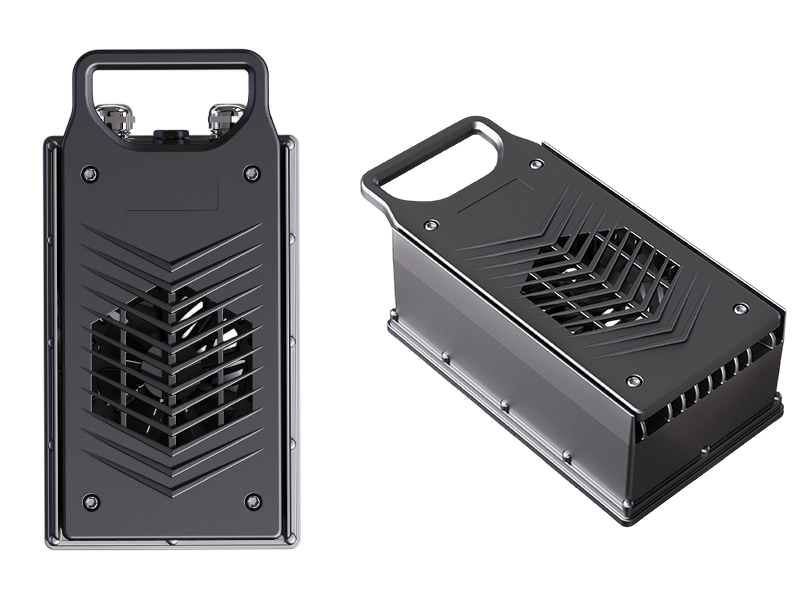
Managing heat is critical for both performance and longevity. Two primary cooling strategies exist. Active cooling with a fan is common in compact, high-power chargers, forcing air over internal heatsinks. While effective, fans are mechanical parts that can fail, accumulate dust, and generate noise. Passive cooling (fanless) utilizes the charger's casing as a large heatsink, providing completely silent operation with no moving parts to fail [citation:5].
While all chargers serve the purpose of recharging batteries, the distinct design features of purpose-built e-bike chargers result in significant differences in performance, safety, and battery longevity. The following table provides a direct comparison to guide e-bike manufacturers, fleet operators, and individual riders in selecting the appropriate charging solution.
| Feature | Purpose-Built E-Bike Charger | Generic/Universal Charger |
|---|---|---|
| Voltage Accuracy | Precise match to battery specifications | Variable, often inaccurate |
| Charging Algorithm | CC/CV with BMS communication | Simple or inappropriate algorithm |
| Safety Protections | Comprehensive (OVP, OCP, OTP, reverse polarity) | Limited or absent |
| Certifications | CE, UL, FCC approved | Often uncertified |
| Fire Risk | Minimal with proper use | Significantly higher [citation:14] |
| Ideal Applications | E-bikes, e-scooters, micromobility | Not recommended [citation:15] |
The choice between a purpose-built e-bike charger and a generic alternative is not merely a matter of cost. Using an incompatible charger can cause the battery to ignite and result in a serious fire [citation:14]. The CPSC urges consumers to only use the charger provided with their device or a verified replacement from the manufacturer [citation:15].
The physical connection between the charger and the battery is a critical interface. The market uses several standard connectors, and the e-bike battery charger must be equipped with the correct mating part for the specific battery. Common connectors include barrel connectors (5.5mm x 2.1mm / 2.5mm) on many entry-level and mid-range e-bikes, XLR connectors on higher-quality e-bikes, and proprietary connectors used by major brands like Bosch, Brose, and Yamaha [citation:4]. A poor-quality connector can introduce resistance, leading to heat buildup, voltage drop, and potential fire risk.
For businesses involved in international trade and manufacturing, sourcing e-bike chargers from a reliable supplier is paramount. Exporters should prioritize suppliers with a proven track record and established credentials, such as those with extensive industry experience, advanced manufacturing facilities, and comprehensive quality control systems.
Key quality parameters to consider when evaluating e-bike chargers include:
The e-bike charger represents a critical component in the electric mobility ecosystem, directly influencing battery lifespan, safety, and user satisfaction. The combination of precise voltage matching, intelligent charging algorithms, comprehensive safety features, and certified construction makes purpose-built chargers an essential investment for e-bike manufacturers, fleet operators, and individual riders.
For e-bike manufacturers, fleet operators, and individual riders, understanding the unique advantages and specifications of quality e-bike chargers is essential for informed selection. By choosing high-quality chargers from reputable manufacturers, businesses and consumers can ensure the safety, reliability, and longevity of their e-bike batteries while avoiding the significant fire hazards associated with incompatible "universal" chargers [citation:14][citation:15].
Modern, quality e-bike battery chargers are designed with intelligent microcontrollers that automatically stop charging once the battery is full. They typically enter a standby or maintenance mode. However, as a best practice for ultimate safety and energy conservation, it is advisable to unplug the charger once charging is complete. The CPSC recommends unplugging the charger from the device when the charge cycle is complete and never leaving it plugged in for long periods [citation:14].
Using the wrong e-bike battery charger can have serious consequences. If the charger's voltage is too high, it will force excessive current into the battery, leading to severe overheating, potential fire, and permanent destruction of the battery cells. If the voltage is too low, the battery will not charge fully, leading to reduced range. The CPSC has received reports of fires and thermal incidents involving incompatible chargers [citation:14].
The lifespan of an e-bike battery charger varies based on its build quality, usage patterns, and environmental conditions. A high-quality charger can last for 3 to 5 years or longer. Key factors influencing longevity include the quality of internal components, thermal stress, and the reliability of any cooling fans. Regular inspection and proper usage will help maximize its operational life.
Most e-bike battery chargers provide clear visual indicators of charging status. A red or orange light typically indicates active charging. The light then changes to green or blue once the battery nears full capacity. Some advanced chargers may feature a digital display showing voltage, current, or charge percentage. Additionally, many e-bike batteries have a built-in charge indicator.
Charging an e-bike battery indoors is common but should be done with awareness. Always charge on a hard, non-flammable surface away from flammable materials. Ensure the area is well-ventilated and that the charger is not covered. Use only the charger supplied with the battery or a certified replacement. Many manufacturers recommend not charging unattended overnight as an extra safety measure [citation:14].
1. Texas Instruments. (2024). Universal Input, 500W CC and CV E-Bike Charger Reference Design. TI Technical Document TIDT411.
2. Texas Instruments. (2024). Universal Input, 500W Constant Current and Constant Voltage E-Bike Charger Reference Design. TI Technical Document TIDT400.
3. HKTDC Sourcing. (2026). E-Bike Charger with Microcontroller. Product Listing.
4. Shimano. (2024). STePS EC-E6002 Battery Charger. Product Specifications.
5. FSP Technology. (2026). FSP059-7S2AC8 Battery Charger. Product Catalog.
6. MEC Power Solutions. (2026). NOVA-750F Lithium Charger. Product Catalog.
7. U.S. Consumer Product Safety Commission. (2024). CPSC Urges Consumers to Not Buy or Use "Universal" Chargers with Micromobility Products Due to Fire Hazard. CPSC News Release.
8. U.S. Consumer Product Safety Commission. (2024). Commissioner Trumka Urges Consumers Not to Use "Universal" Chargers for E-bikes Because of Fire Hazard. CPSC Statement.

 No.18-9 Zhang Hong Road ,Huishan District,Yanqiao Street,Wuxi City,Jiangsu Province,China
 +86-510-83138966
 [email protected]
TALK TO US
Copyright © Wuxi Dpower Electronic Co., Ltd. All Rights
Reserved.
Custom Smart Lithium Battery Charger Manufacturer